Differences Between Hajj Tamattu, Ifrad, and Qiran: Which One Is Most Suitable for Indonesian Pilgrims?

Table of Contents

In Islam, Hajj can be performed in three valid ways: Hajj Tamattu, Hajj Ifrad, and Hajj Qiran. All three are accepted forms of Hajj, but they differ in terms of intention, sequence of rituals, ihram condition, tahallul, and the obligation of dam.
For many pilgrims, especially those preparing for Hajj for the first time, understanding the differences between Hajj Tamattu and Ifrad, as well as the meaning of Hajj Qiran, is very important. This knowledge helps pilgrims follow the manasik guidance more clearly and avoid confusion during the actual journey in the Holy Land.
This article is written as a comparison guide. If you want to understand Hajj Tamattu in more detail, including its meaning, steps, and benefits, you can also read Buminata’s guide about what Hajj Tamattu is.
What Are the Three Types of Hajj?
The term types of Hajj refers to the different ways pilgrims combine or separate Umrah and Hajj during the Hajj season. The core pillars of Hajj remain the same, but the sequence, intention, and obligation of dam may differ.
The three types of Hajj are:
- Hajj Tamattu
The pilgrim performs Umrah first during the Hajj months, exits ihram through tahallul, then enters ihram again for Hajj. - Hajj Ifrad
The pilgrim performs Hajj only, without combining it with Umrah at the beginning. - Hajj Qiran
The pilgrim combines Umrah and Hajj in one intention and one state of ihram.
In simple terms, Hajj Tamattu separates Umrah and Hajj, Hajj Ifrad focuses only on Hajj, while Hajj Qiran combines both Umrah and Hajj in one ihram.
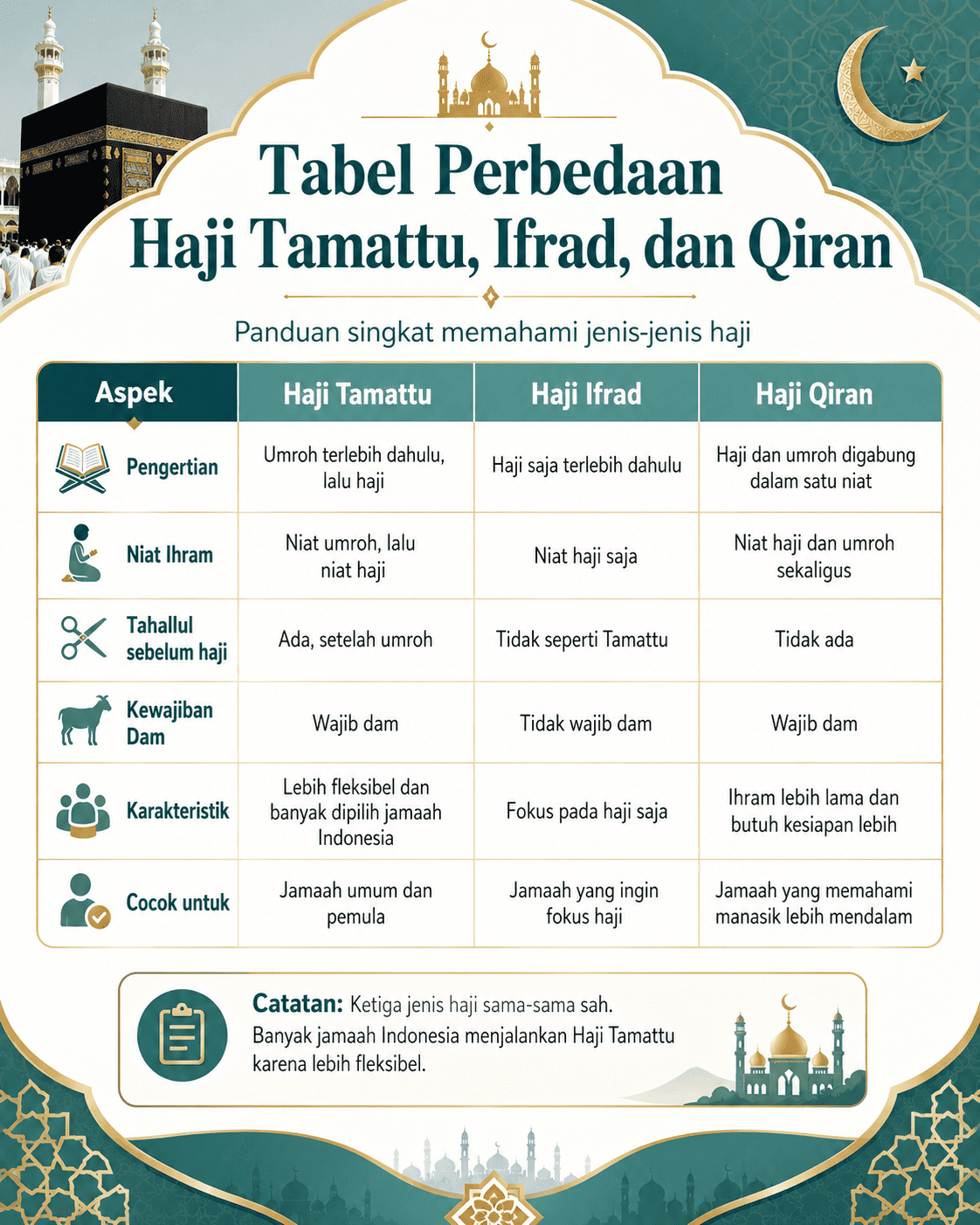 perbedaan haji tamattu ifrad dan qiran.png 436.92 KB
1. Hajj Tamattu: Performing Umrah First, Then Hajj
Hajj Tamattu is performed by doing Umrah first during the Hajj months. After completing Umrah, the pilgrim exits ihram through tahallul. Later, when the time for Hajj arrives, the pilgrim enters ihram again and performs the Hajj rituals.
The simple sequence is:
- Enter ihram for Umrah from the miqat
- Perform tawaf for Umrah
- Perform sa’i between Safa and Marwah
- Perform tahallul
- Wait until the 8th of Dzulhijjah
- Enter ihram again for Hajj
- Complete the Hajj rituals
This is why Hajj Tamattu is commonly chosen by Indonesian pilgrims. After completing Umrah, pilgrims have time to rest before the peak days of Hajj, such as wukuf in Arafah, mabit in Muzdalifah, and stoning the jamarat in Mina.
Benefits of Hajj Tamattu
Hajj Tamattu offers several practical benefits:
- Pilgrims have time to rest between Umrah and Hajj
- The sequence is easier to understand for beginners
- It suits pilgrims arriving from outside Saudi Arabia
- It gives time to adapt to the weather and environment
- It is often more comfortable for elderly pilgrims when the schedule is well arranged
Because pilgrims exit ihram after Umrah, they do not have to remain in ihram continuously until the peak of Hajj. This can make the journey more comfortable, especially for first-time pilgrims.
However, Hajj Tamattu comes with one important obligation: dam is required.
2. Hajj Ifrad: Performing Hajj Only
Hajj Ifrad is performed with the intention of Hajj only. In this type of Hajj, the pilgrim does not combine Umrah with Hajj at the beginning. If the pilgrim wants to perform Umrah, it may be done separately after completing the Hajj rituals.
The simple sequence is:
- Enter ihram with the intention of Hajj from the miqat
- Perform the Hajj rituals
- Remain under the rules of ihram until the proper tahallul
- After Hajj is completed, Umrah may be performed separately if possible
The clearest difference between Hajj Tamattu and Hajj Ifrad is the order of worship. Hajj Tamattu begins with Umrah, followed by Hajj. Hajj Ifrad, on the other hand, focuses only on Hajj.
Benefits of Hajj Ifrad
Hajj Ifrad has several advantages:
- No dam obligation
- Focuses purely on Hajj
- Simpler intention because it does not combine Umrah and Hajj
- Suitable for pilgrims who want to perform Hajj directly
However, Hajj Ifrad also requires physical and mental readiness. Since there is no Umrah followed by tahallul like in Tamattu, some pilgrims may find it less flexible.
For Indonesian pilgrims, Hajj Ifrad is generally less common than Hajj Tamattu because the typical travel pattern of Indonesian pilgrims is more suitable for Tamattu. Even so, Hajj Ifrad is still valid and recognized in Islamic jurisprudence.
3. Hajj Qiran: Combining Hajj and Umrah in One Intention
Hajj Qiran is performed by combining the intention of Umrah and Hajj in one ihram. In this type of Hajj, the pilgrim does not exit ihram after Umrah because Umrah and Hajj are joined together in one continuous ritual.
The simple sequence is:
- Enter ihram from the miqat with the intention of Hajj and Umrah together
- Remain in ihram
- Perform the Hajj rituals
- Umrah is included within the Hajj sequence
- Tahallul is performed at the proper time during Hajj
Hajj Qiran can be more challenging because the pilgrim remains in ihram for a longer period. This means the pilgrim must observe the restrictions of ihram for a longer time compared to Hajj Tamattu.
Benefits of Hajj Qiran
Hajj Qiran offers several benefits:
- Hajj and Umrah are combined in one sequence
- There is no need to separate the intention for Umrah and Hajj
- It may suit certain travel conditions or pilgrims with specific schedules
However, Hajj Qiran also requires stronger preparation because of the longer ihram period. For beginners, this type of Hajj may feel more demanding.
Like Hajj Tamattu, Hajj Qiran also requires dam.
Main Differences Between Hajj Tamattu and Ifrad
Because the main keyword of this article is differences between Hajj Tamattu and Ifrad, this section is important to make the comparison clearer.
1. Sequence of Worship
Hajj Tamattu begins with Umrah. After completing Umrah, the pilgrim exits ihram through tahallul, then enters ihram again for Hajj.
Hajj Ifrad begins directly with the intention of Hajj. The pilgrim does not perform Umrah first as part of the same sequence.
2. Dam Obligation
Hajj Tamattu requires dam because the pilgrim benefits from performing Umrah first, exiting ihram, and then entering ihram again for Hajj.
Hajj Ifrad does not require dam because the pilgrim performs Hajj only and does not combine it with Umrah in the same way as Tamattu or Qiran.
3. Comfort and Flexibility
Hajj Tamattu is generally more flexible because pilgrims have a rest period after Umrah. This is one of the reasons why many Indonesian pilgrims prefer it.
Hajj Ifrad is more focused on Hajj alone. It may be suitable for pilgrims who want a simpler structure without performing Umrah at the beginning.
Differences Between Hajj Tamattu and Qiran
Hajj Tamattu and Hajj Qiran both involve Umrah and Hajj in the same Hajj season. Both also require dam. However, the way they are performed is different.
In Hajj Tamattu, Umrah and Hajj are separated. The pilgrim performs Umrah first, exits ihram, then later enters ihram again for Hajj.
In Hajj Qiran, Umrah and Hajj are combined in one intention and one ihram. The pilgrim does not exit ihram between Umrah and Hajj.
The easiest way to understand the difference is:
- Tamattu: Umrah and Hajj are separated by tahallul
- Qiran: Umrah and Hajj are combined without tahallul in between
Which Type of Hajj Is Most Suitable for Indonesian Pilgrims?
In general, many Indonesian pilgrims perform Hajj Tamattu because it is more flexible and matches the travel pattern of pilgrims coming from outside Saudi Arabia.
Some reasons why Hajj Tamattu is commonly chosen include:
- Indonesian pilgrims usually arrive before the peak days of Hajj
- They can perform Umrah first
- There is time to rest before wukuf in Arafah
- The sequence is easier to understand during manasik
- It is more suitable for beginners and elderly pilgrims
However, the type of Hajj should still follow the guidance of the appointed religious guide, the program organizer, and the travel arrangement. Pilgrims should not rely only on theory but should attend manasik sessions seriously before departure.
Important Insight: Do Not Just Memorize the Names
Many pilgrims have heard the terms Tamattu, Ifrad, and Qiran, but not everyone understands the actual differences in practice.
This is important because once pilgrims are in the Holy Land, a clear understanding of the sequence helps them follow the guidance more calmly.
A common mistake is assuming that all types of Hajj are exactly the same. In reality, differences in intention, tahallul, and dam can affect how pilgrims prepare themselves physically and mentally.
For example, pilgrims performing Hajj Tamattu must understand that after completing Umrah and tahallul, they will enter ihram again for Hajj. Meanwhile, pilgrims performing Qiran must be ready to remain in ihram for a longer period.
Tips for Choosing the Right Hajj Program
Choosing the right Hajj program is not only about understanding Islamic law. It also depends on physical readiness, travel schedule, age, comfort, and the quality of guidance during the journey.
1. Follow the Manasik Guidance
Religious guides play an important role in explaining which type of Hajj will be used in the program. Do not hesitate to ask questions if anything is unclear.
2. Consider Physical Condition
For elderly pilgrims or those with health concerns, a program that provides more rest time may be more comfortable. This is one reason why Hajj Tamattu is often considered practical for many Indonesian pilgrims.
3. Understand the Dam Obligation
If the program uses Hajj Tamattu or Qiran, pilgrims should understand that dam is required. Ask the organizer whether dam is already included in the package or paid separately.
4. Choose an Official and Experienced Travel Agency
The quality of manasik and guidance depends greatly on the travel organizer. That is why choosing an official and experienced Hajj travel agency is very important.
Buminata Wisata is a Bali-based travel agency that has served pilgrims since 1994. With experience in Hajj and Umrah travel, Buminata focuses on professional guidance, comfort, and trusted service for pilgrims.
Recommendation for Buminata Pilgrims
For pilgrims who want a more peaceful and well-guided Hajj journey, it is important not to focus only on travel facilities. Proper religious guidance, clear manasik explanations, and professional assistance are also essential.
Buminata Wisata helps pilgrims prepare their journey more confidently, from consultation and administration to manasik guidance and travel assistance.
With decades of experience, Buminata understands that a meaningful Hajj journey is not only about hotels and transportation, but also about helping pilgrims understand the flow of worship clearly.
If you are still unsure about Hajj Tamattu, Ifrad, or Qiran, you can consult with the Buminata Wisata team for clearer guidance.
Conclusion
The differences between Hajj Tamattu, Ifrad, and Qiran lie in how Umrah and Hajj are performed during the Hajj season.
Hajj Tamattu is performed by doing Umrah first, exiting ihram through tahallul, then entering ihram again for Hajj. It is commonly chosen by Indonesian pilgrims because it is more flexible, although dam is required.
Hajj Ifrad is performed by doing Hajj only. It does not require dam and is suitable for pilgrims who want to focus solely on Hajj.
Hajj Qiran combines Hajj and Umrah in one intention and one ihram. It also requires dam and demands stronger readiness because the pilgrim remains in ihram longer.
All three types of Hajj are valid. The best choice depends on the pilgrim’s condition, travel schedule, and the guidance of the religious supervisor.
Planning your Hajj journey and still unsure which type of Hajj applies to your program?
Consult your pilgrimage plan with Buminata Wisata, an experienced Hajj and Umrah travel agency from Bali, serving pilgrims since 1994.
With professional guidance, clear manasik preparation, and trusted service, Buminata helps pilgrims prepare their journey with more confidence and peace of mind.
Contact Buminata Wisata today and start preparing your Hajj journey with trusted guidance.
FAQ
1. What is the difference between Hajj Tamattu and Ifrad?
Hajj Tamattu is performed by doing Umrah first, exiting ihram through tahallul, then entering ihram again for Hajj. Hajj Ifrad is performed with the intention of Hajj only, without performing Umrah at the beginning.
2. What is the difference between Hajj Tamattu and Qiran?
Hajj Tamattu separates Umrah and Hajj with tahallul in between. Hajj Qiran combines Umrah and Hajj in one intention and one ihram without tahallul in between.
3. Is dam required for Hajj Tamattu?
Yes. Dam is required for Hajj Tamattu because the pilgrim performs Umrah first, exits ihram, and then enters ihram again for Hajj.
4. Is dam required for Hajj Ifrad?
No. Hajj Ifrad does not require dam because the pilgrim performs Hajj only.
5. Is dam required for Hajj Qiran?
Yes. Hajj Qiran requires dam because the pilgrim combines Hajj and Umrah in one intention and one ihram.
6. Which type of Hajj is most common for Indonesian pilgrims?
Hajj Tamattu is commonly chosen by Indonesian pilgrims because it is more flexible and gives pilgrims time to rest between Umrah and Hajj.
7. Are Hajj Tamattu, Ifrad, and Qiran all valid?
Yes. Hajj Tamattu, Hajj Ifrad, and Hajj Qiran are all valid as long as the requirements and pillars of Hajj are fulfilled properly.
References
- NU Online — Differences in the Procedures of Hajj Tamattu, Qiran, and Ifrad
- Rumah Fiqih — Consultation on Types of Hajj
- Rumaysho — Three Types of Hajj: Qiran, Tamattu, and Ifrad
- Buminata Wisata — What Is Hajj Tamattu?
 Check Schedule
OTHER HAJJ
4 August 2026 - Learn why Hajj waiting times in Indonesia can last for decades and discover how Buminata Hajj Plus offers a faster departure estimate, premium hotels, and world-class airline services.
25 July 2026 - The cost of Buminata Hajj Plus 2026 varies depending on the package you choose: Executive Double, Executive Triple, or Executive Quad. The main difference lies in room occupancy, while all packages include professional guidance, premium accommodations near the holy mosques, and comprehensive support throughout the pilgrimage. Choosing the right package depends on your preferred level of privacy, comfort, and budget.
19 July 2026 - Learn complete Hajj requirements including eligibility, Istitha'ah, health preparation, and conditions every Muslim must fulfill before departure.